The Empire Within
How Rome's Patterns Still Shape Us—and the Scar We Carry

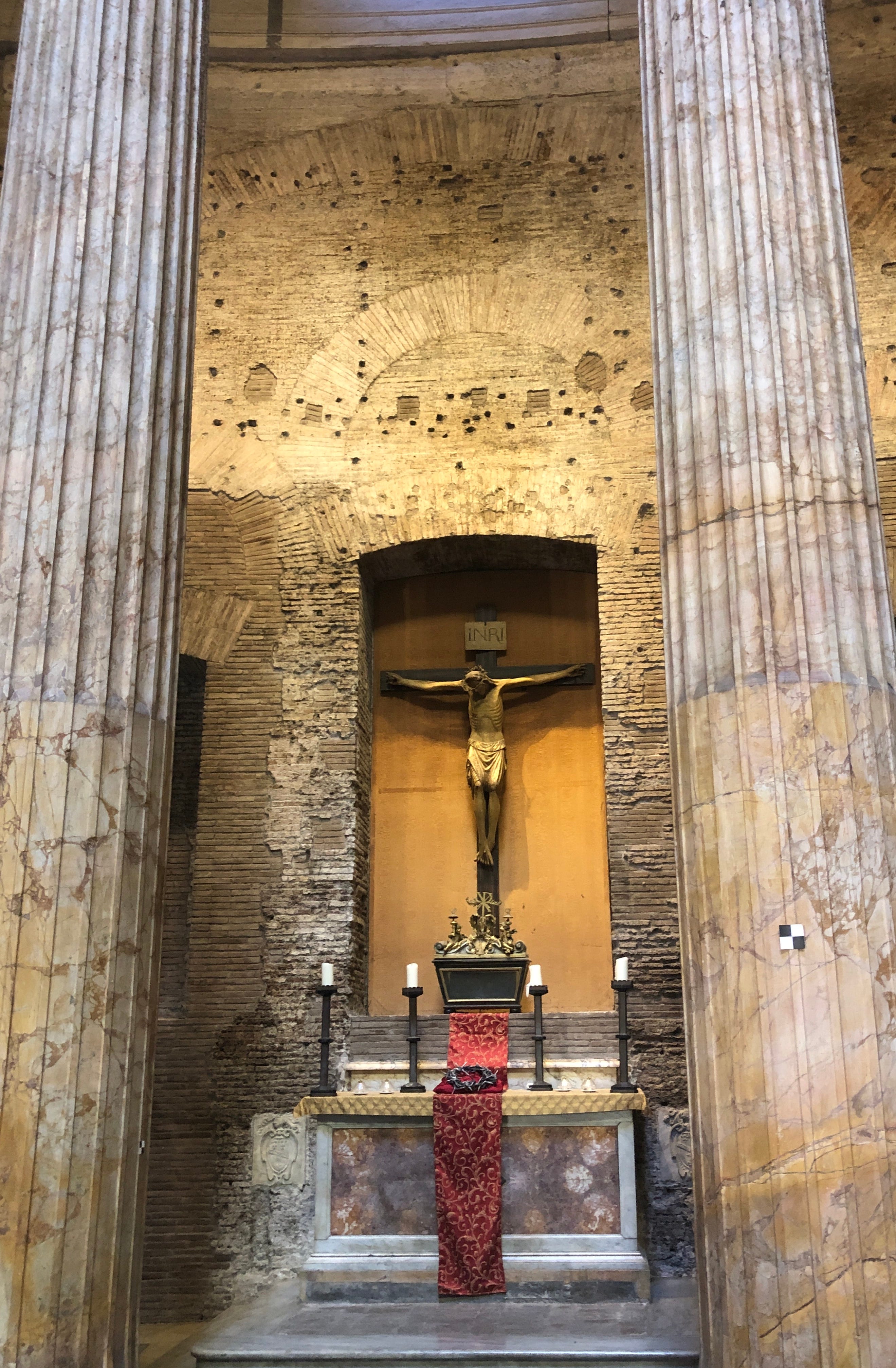
The picture shows a cross beneath the dome of the Pantheon. Pull back the frame and three things sit together: fluted marble columns from a world of gods and civic ritual, patched Roman brickwork telling of repair and reuse, and a wooden crucifix with a bronze Christ placed in the Christian basilica that grew into this pagan temple. The photograph I took—the crucifix silhouetted against brick and column—summed up my trip. It wasn’t just a composition; it was a statement of all that shapes our world today.
Rome, in a single frame, teaches a lesson about how power multiplies and mutates: it absorbs what it finds, repurposes it and then wears the relics of the old world as costumes for the new. And while all this occurs, its long arcs hide beneath.
I want to take you on the walk I actually did through that city, following questions as they unfolded. All of this occurred, with great synchronicity, shortly after I finished a previous article about Rome’s colonisation of my home country England and its replication within my own life journey [Link to Article].
What follows braids two strands: how Rome became itself—shepherds, kings, republics, emperors, technological genius and imperial reach—and how religion moved from an outward public craft to an inner claim, then back into an instrument of structure and control. The threads knot together when the empire, failing as a political form, reappears as a spiritual and institutional force. And then I bring it here, to our present day, to the patterns still running through us.
Day 1: The Colosseum and the Forum—Where It First Became Apparent
The Colosseum landed on me like a fact you already knew but hadn’t felt in your body. Standing beneath those tiers I could see the engineering—the rhythm of arches, the layered orders of Doric, Ionic, Corinthian—and I could feel the social choreography: how a city could build a mechanism not just for entertainment but for ordering citizens. It’s one thing to know “bread and circuses” as a slogan; it’s another to stand where the emperor’s gestures and the roar of the crowd executed a political lesson daily. The Colosseum was spectacle designed at civic scale: life, death, performance and a repeated demonstration of who could decide who lived.
From there I walked into the Forum—the machinery of law, of public speech, of victory. The Forum felt like the city’s mind; the Colosseum its theatre of feeling. You can walk between the points where laws were proclaimed and decrees posted. You step on thresholds where an empire defined rights and obligations and the very language of rule.
What made this first day decisive was not just the scale but the way everything wore its ancestry openly. The structures weren’t pure Roman inventions. Rome had been colonised before it became the coloniser: shepherd settlements on the Palatine and surrounding hills; a landscape shaped by Etruscan drains and urban forms and Greek temples imported from Magna Graecia. The Romans didn’t build on an empty place; they built through sediment.
The genius of Rome wasn’t purity; it was appetite: to take useful things—engineering, gods, myths, calendars—and make them Roman, then imperial. This was colonisation by absorption: not only the annexation of land but the annexation of other peoples’ myth and machinery.
Walking there I began to ask the question that would follow me through the city: what does it mean to be colonised from the inside? If Rome learned early to render otherness into itself—to rename gods, to adopt rituals, to refashion elites—then the template for empire isn’t just violence; it’s assimilation. The violence is the scaffold, the assimilation the upholstery. That double motion—take, then make it yours—repeats over and over. We see the obvious violence, but the structures of power lurk and shapeshift in the less obvious: the unseen patterns of absorption.
Shepherds, Kings, Republics, Emperors—The Political Arc Beneath the Stones
If we step back and trace the high-level story, the sequence matters because each political form taught a technique of ordering and organising people. Rome begins in a mosaic of villages and shepherd encampments; you can still imagine wooden huts on the Palatine overlooking the Tiber. From there came kings (partly Etruscan in Rome’s story—the fasces and ritual trappings arrived with them), then the Republic with its Senate and officials, and finally the Empire with its concentrated executive power in the person of the emperor.
This arc—from kin-based, to ruling elite, to imperial—is more than timeline. Each shift is also a shift in how people experience meaning and authority. Under the shepherding life, meaning is local and embedded; gods and ancestors are household affairs. With kings came hierarchy and ceremony; with republics, the idea that law could be public and predictable; with emperors, spectacle and the centralisation of violence and legitimacy.
The Roman Republic gave the world legal concepts—citizenship, contracts, public office—that could travel. The Empire gave it roads, aqueducts, grain supply and the hard lesson that a city could be sustained only if the logistics of supply and meaning were managed together.
At its height Rome’s urban scale was extraordinary: up to a million inhabitants by most scholars’ estimates in the first and second centuries CE. The city’s maintenance required vast systems—aqueducts supplying water, granaries, tax networks—that depended on imperial reach. When those logistical threads frayed, the city shrank dramatically. The city that hosted spectacles for hundreds of thousands ended, over centuries, with perhaps a few tens of thousands inhabiting its heart in the early Middle Ages. Whole institutions that seemed eternal—the daily grain dole, the aqueduct-fed fountains, the engineering corps—faltered when the imperial economy changed.
Yet the fall of the imperial polity did not mean the disappearance of Rome’s habit. The city shrank physically, but many of the ideas and methods of rule were parked in other forms; they reappeared later. This became crucial as I began to look at religion across the city: what if the empire’s way of organising people and meaning didn’t vanish but slipped into a different garment?
The Machinery of Roman Life—Technology, Law, Spectacle
I can still feel the Appian Way under my feet: original paving slabs, their edges worn by millions of shod feet. The roads are a reminder that Rome’s genius was practical and material. The aqueducts carried water; the Cloaca Maxima drained the city. Roman concrete created vaults and domes that lasted. Baths were social technology: steam, heat and gossip that lubricated civic life. The city’s legal genius—codified rights, process, contracts—made trade and administration possible across distances.
What astonishes is how much of this was lost or neglected after the Western Empire’s breakdown. Bridges fell to disrepair. Aqueducts were cut by invaders or fell into disuse. Public life changed from urban, organised, and integrated—a system-level civilisation—to a more localised, subsistence pattern. The shift was economic but also psychological: when the centre could not guarantee provision, people retreated to the safety of village ties, fortified houses and local landlords. Knowledge that had been largely craft-based—the skills to make durable concrete, the competence to coordinate aqueduct maintenance—diminished without the structures that demanded it.
This matters because losing scale is not the same as losing competence. Many technical skills continued in pockets—military engineers, monastery scriptoria, Byzantine centres of learning—but the integrated urban system was gone. Institutions that rely on scale—armies, roads, food supply, municipal entertainments—need both the material and the collective belief that such a system is possible. That belief, I realised standing among the ruins, was as much a political resource as grain.
And this is where the story turns. Because when one belief system falters, another rises to take its place.
The City Does Not Die: It Morphs Into Religion
Here is the insight that threaded itself like a red line through my days in Rome: a political form can reappear as a spiritual or institutional form. When the imperial institutions failed to deliver, other institutions filled the vacuum. The Church did not merely become the biggest landowner; it became the manager of social meaning.
To understand how this happened, we need to go back to Christianity’s origins—and to the tradition it grew from.
Judaism: Exile, Covenant and the Psychology of Deferred Hope
Judaism’s ancient story is one of covenant and survival. The Israelite religion developed in a Near Eastern environment thick with gods and kings, but something distinctive happened. Covenant language made people into a people: bound by law, ritual and story. The traumatic displacements—notably the Babylonian Exile—sharpened a theology in which God’s fidelity and future restoration became central. The prophets spoke a language of correction and hope; the community consolidated identity through scripture and law.
Meaning, in this frame, was often future-oriented: promises of restoration, a messiah to come, a new age. That forward-leaning hope is not a minor theological detail. It’s a psychological programme. If your identity is formed by exile, what sustains you is a story that promises redemption in the future—rebuild the temple, return to the land, witness the vindication of the righteous. The future carries the weight of meaning that the present cannot.
But there’s another layer here, one often overlooked. Before the codified religions, before exile and covenant, the ancient world was thick with spirits. Trees, rivers, animals, skies—all held life, all demanded respect. This animistic consciousness wasn’t simply “belief”; it was a way of being in continuous relationship with the living fabric of the world. Such a worldview located authority everywhere, not in one throne, temple, or book. It was inherently resistant to imperial logic because it couldn’t be centralised or controlled.
As empires rose—first in the ancient Near East, then Rome—they worked to suppress this orientation. Sacred groves were felled, shrines destroyed, rituals outlawed, elders silenced. To the imperial eye, animism was chaos—too dispersed, too uncontrollable, too hard to tax or govern. Yet like underground springs, it refused to disappear. It flowed quietly in folk practices, seasonal festivals, herbal medicines and whispered stories passed from grandparents to children.
This tension—between living, decentralised relationship with the world and centralised systems of meaning—runs beneath everything that follows.
Jesus and the Present: Why This Is a Pivot
When Jesus’s teaching—”the kingdom is at hand”—arrived in that context, it was not simply spiritual novelty; it was a profound reorientation of time and meaning. Rather than saying “await a future deliverance,” Jesus taught presence: God is acting now, in mercy, in healing, in community. That is why his message read as both good news and threat.
At first, Christianity was marginal—Jewish in origin, a small sect in a fractious Roman world. Its earliest followers were Jews who believed that Jesus of Nazareth had inaugurated “the kingdom” in a way that transformed Jewish expectation. Crucially, the earliest Christian communities were not primarily political; they were spiritual communities that cared for the poor and isolated and promised a different kind of belonging.
Standing in the Pantheon with that cross between column and brick, it struck me how poignant the crucifixion is as a political event. Jesus was executed by the Roman state—crucifixion was public, humiliating, designed to mark political enemies. Yet the symbol of that execution became the central image of a religion that claimed a life-giving presence at the very centre of empire.
Jesus’s teaching threatened the staples of imperial control for several reasons. First, the altar of Roman authority was public ritual and obedience; Jesus taught interiority and direct access to God. Second, the empire’s legitimacy ran through ceremonial homage and the imperial cult; Jesus’s lordship-language displaced Caesar’s claims. Third, the social logic of patronage and hierarchy was challenged by a community ethic of sharing and hospitality. If meaning and belonging could be found in small, countercultural communities, then the empire’s claim on identity and allegiance loosened.
That potential is why an empire does not leave a living threat be.
From Presence to Protocol: How the Movement Became the Machine
But the story does not stay in the margins. Two pivotal movements make Christianity central: the missionary work of figures like Paul who spread the message beyond Jewish communities (opening it to Gentiles and making it a trans-ethnic faith), and later, the conversion of Constantine. Constantine’s conversion and the Edict of Milan in 313 CE changed the dynamic: Christianity moved from outlawed sect to privileged religion. When Theodosius made Christianity the state religion at the end of the fourth century, the Church acquired political legitimation and administrative reach.
Once inside that legitimating structure, Christianity could provide continuity and administration where civil institutions were failing. Cardinals became civic leaders; monasteries preserved texts; bishops administered welfare. The religious structure inherited—and repurposed—many of the empire’s forms: hierarchical authority, an imperial rhetoric of salvation, ceremonies that bound citizens to a public spectacle.
Where do presence and immediacy go when a movement scales? They get codified. Apostolic charisma gives way to episcopal authority; oral teaching becomes creed; liturgy replaces improvisation. The great councils of the fourth and fifth centuries shaped doctrine—crafted creeds that set the lines of orthodoxy. Theological debates about the nature of Christ and the Trinity were not metaphysical hair-splitting alone; they were answers to practical questions about unity and order in a world of competing claims.
Two critical psychological pivots come into focus here. One is the doctrine of original sin—most famously articulated by Augustine. If all humans inherit a sinful condition, then sin is not merely an action but a state; salvation needs mediation. The ritual apparatus of absolution, baptism, penance, and later confession, become technologies for managing souls. Guilt is not merely an interior conscience; it’s a social mechanism that channels people toward sanctioned forms of repayment and reconciliation. It makes obedience and institutional mediation necessary.
The second pivot is the structuring of hope around institutions rather than ongoing prophetic rupture. Salvation becomes sited—in Church words, sacraments, bishops—rather than always present in the communal life of followers.
So we move from presence (Jesus) to protocol (Church). We move from the claim “God is here” to the claim “God is mediated through us.” The old political centre had atrophied but the Church became a different centre. Rome as a city may have contracted, but the Roman form of ordering people no longer depended solely on emperors; it continued as an ecclesiastical project. The empire, in a sense, did not die so much as change clothing.
Catholicism as a New Empire: Spectacle, Hierarchy and Global Reach
By the time I reached the Vatican, the pattern was unmistakable. Once Christianity became a state religion and then a church-empire, it took on many of Rome’s old tools but in a different register. Cathedrals and liturgies became the new spectacles; popes, bishops and cardinals became the hierarchical equivalents of imperial offices. The Church inherited the social technologies Rome used: public ritual, legal codes, distribution networks (now for charity and spiritual services) and a rhetoric of universal claim.
Walking through the Vatican Museums, I was struck by the sheer scale of accumulation—room after room of art, artifacts, treasures. The conversion of entire regions by medieval missionary effort reproduced Rome’s ancient template: incorporate the local gods as saints, build a church on a sacred site, consecrate rulers in Christian images. The same absorption and repurposing, now in spiritual garb.
When European powers, centuries later, set sail for the Americas and beyond, they carried a double cargo: ship and cross. Missionary zeal often accompanied conquest; conversion and colonisation were braided together. Conversion was sometimes sincere, often coerced, sometimes syncretic. The moral framing—that bringing Christianity was a civilising task—became a widely accepted justification for the dispossession and violence that colonisation entailed.
The Inquisition and other mechanisms are the flip side of institutionalisation’s need to keep its boundaries secure. Where Rome once exercised empire with legions and law, the Church exercised spiritual sovereignty—with censures, inquisitors and a judicial language of orthodoxy and heresy. Guilt and confession, the very things that had spiritual genealogies, also became instruments of social discipline.
Renaissance: Eruption, Redirection and Containment
In Florence, standing before Michelangelo’s David and later beneath the Sistine Chapel ceiling, I felt the tension of another pivot. The Renaissance is often remembered as a graceful recovery of classical beauty—marble statues dusted off, ancient texts translated, domes and arches lifted once more into the skyline. But to see it only as recovery is to miss its force.
The Renaissance was an eruption—a dangerous counter-movement that cracked open what had been sealed. Artists and thinkers dared to imagine a world brimming with vitality, where the human body, the natural world, and the cosmos could be celebrated as alive and meaningful in themselves, not only through the lens of salvation.
But the eruption did not unfold unchecked. Power moved quickly to redirect it. Michelangelo, whose sculptures embodied raw human dignity, was pressed into service painting the Sistine Chapel ceiling under papal commission—genius contained within sanctioned walls. Knowledge that might have widened the horizon was carefully curated: texts chosen, philosophies framed, art patronised to reinforce the very structures it had threatened. The Church, facing the tremors, doubled down—inquisitions, censorship, the silencing of radical voices.
We see the same dynamic now with the internet and social platforms. What began as an eruption—radical decentralisation, the promise of unmediated connection, knowledge freely shared—has been systematically redirected. The energy that might have dismantled old hierarchies was absorbed into new ones. Platforms have become gatekeepers; algorithms have become curators; what we see, share and believe is shaped by architectures of attention designed not to liberate but to capture. The Renaissance taught power how to contain eruption by patronage and curation. The digital age teaches us that the same pattern scales: absorb the energy, redirect it, claim it as your own.
The Renaissance, then, was not a break from the imperial pattern but another layer of it—and neither is our digital revolution.
Modern Echoes—Stadiums, Corporations and the Architecture of Control
Back in modern Rome, standing in squares full of cafés and buskers, I kept seeing the long shadow. Sports stadiums are descendants of the amphitheatre; civic rituals have been transformed into televised spectacles; national ceremonies still borrow the language of pageant and victory. The modern corporation borrows Rome’s logic of scale, hierarchy and extraction: supply chains that draw resources from faraway lands; infrastructure projects that require administrative capacities that only large entities can muster.
We’ve exported Roman technique into modern institutions. The pattern repeats: we promise security and belonging, and we deliver hierarchical organisation that places meaning outside ourselves—”trust the system; it will keep you safe.” Where the Church once enforced orthodoxy, now markets, bureaucracies and media enforce norms. The emotional register changes—guilt becomes productivity pressure, omission of ritual becomes social exclusion—but the underlying dynamics persist.
This is not to make a simple equivalence. Institutions are plastic: they have virtues and vices. The point is diagnostic: the architecture of human life persists in forms that continue to shape inner life and social practice. If we want to dismantle the harmful patterns, we need to see that the structure has history and logic, not simply immediate malice.
Humanity’s Journey: The Wound and the Search
Up to now, we’ve been looking at Rome, religion, empire, colonisation. But step back for a moment. What if we saw this not just as the story of nations or systems of power, but as the story of humanity itself?
Because across it all, a deeper pattern comes into view: again and again, people have reached for the same things, the same needs. Continuity. Belonging. Meaning. Grounding. Protection. These are the constants of our species, the threads that keep reappearing no matter the age or geography.
The shepherds of early Rome looked for continuity in their ancestral ways; the Republic sought grounding in law and civic order; the Empire reached for meaning through expansion, absorbing others as if more land and more gods would finally fill the void. Judaism, in exile, clung to covenant and deferred hope. Christianity turned that hope into immediacy—here and now—but then institutionalised it, pushing it back into the distance again.
Every pivot, every rupture, is psychological as much as political. When safety felt fragile, people turned outward to systems promising security. When meaning slipped, they sought it in story and ritual. When continuity frayed, they longed for order, even if it was imposed. And in doing so, humanity kept repeating an old wound.
The wound itself becomes clear when we look honestly: repeated power imbalances. Again and again, structures promised protection and continuity only by extracting from those beneath them. That extraction was not just economic but psychological and spiritual, stripping away belonging, dignity and agency.
To understand this, we must widen our lens: history is not a matter of the last century or two. The same dynamics have been shaping humanity for two, three, even four thousand years. The cost has been vast—not only in suffering but in the stifling of human growth and evolution itself. Capacities for deeper relationship, creativity and collective flourishing were amputated or redirected to serve external power.
This is the part we often overlook: the species-level trauma that runs like a scar across our shared history. It explains why we relapse into old patterns, why we find it so hard to live aligned with the deeper laws of life. To see humanity this way—not just as individuals with private struggles, but as a collective being carrying its own inherited trauma—is uncomfortable. It demands responsibility rather than deferral. Yet it is the only way to understand the wound we inherit—and the search we are still on today.
The wound spreads wider than Rome, deeper than Europe. It stretches through the Spanish and Portuguese empires, the British colonial project, the extraction of peoples and lands across the globe. And it is still here, in the hidden patterns of our economies, our organisations, our ways of organising life.
To empathise with humanity is to see not just the cruelty of empire but the fear and longing underneath it: the desperate attempt to hold life together.
Reclaiming the Inner: What Dismantling Looks Like
Here’s the paradox that won’t leave me: Jesus was crucified by the Roman Empire. His presence was its nemesis—giving hope to the subclasses, bringing the divine into the immediacy of the here and now. And yet, within a few centuries, the empire that killed him had wrapped itself in his name. Christianity became the garment the old imperial system wore to survive.
This is where the empire never really ended. It still runs through us today—not just in our politics or economies, but in our inner worlds. We inherit the machinery of guilt, the deferral of hope, the instinct to extract more than we need. We live with the coloniser not only outside us but inside us.
To move differently, we have to begin here: dismantling the empire within. That means stripping away the ingrained foundational patterns that tell us we are not enough, that meaning lies always deferred, that our worth depends on systems of control. It means unlearning the logic of extraction—not just from land and people, but from ourselves.
But the inner is not just individual. It ripples outward. Into our families, where patterns of power imbalances and silence echo across generations. Then into our communities, where the ways we organise either reproduce old hierarchies or allow something more life-giving to emerge. Beyond that, into the collective unconscious—the shared stories, myths and assumptions that shape how we see the world. And ultimately, into humanity itself: the deeper scar and the deeper potential of our species.
This is the heart of the work: to guide people, groups and organisations to remember their true ground. To return to nature, place and purpose as the anchors empire always tried to sever. To see ourselves not as cogs in a machine, nor subjects of a distant power, but as living beings in relationship with the whole.
When we reclaim the inner, something shifts. The same presence that Rome feared in Jesus—the immediacy of life alive here and now—becomes possible in us again. We stop reproducing the old patterns of domination. We begin to cultivate what is truly life-giving. And step by step, the deeper scar of humanity has a chance to heal.
What does this look like in practice? It begins with acknowledging what we carry—not to wallow in it, but to see it clearly. Then it moves to the practical work of dismantling old patterns to make space for re-embedding meaning in living practices: restoring relationship with place and land, rebuilding community not as nostalgia but as living necessity, and finding purpose that serves life rather than extraction.
This is not a return to some imagined past. It’s a remembering—that continuity, belonging and meaning don’t have to be deferred to empires or institutions. They can be lived now, in time and space, here.
Return to the Pantheon
I returned to the Pantheon on my last day in Rome. Standing again beneath the dome, looking up at that cross framed by ancient columns and patched brick, the lesson felt both disquieting and generative.
Three layers of history point at one structural dynamic. Rome’s architecture of absorption taught the world how to organise on scale; Christianity taught the world how to mobilise meaning; colonisation taught the world how to take both and distribute them across continents. Those remain live blueprints.
Yet the photograph also shows the crack. The cross is not simply an overlay; it sits within the older fabric. Presence finds a way into the machine. And that is the real moral of the Graeco-Roman, Judeo-Christian, medieval and modern arcs: power adapts, but presence returns.
The question we face now—given climate collapse, economic concentration and cultural homogenisation—is whether we will keep adding layers of externalised meaning, or whether we will learn to re-embed belonging in living practices.
If you stand in the Pantheon and look at that crucifix, you will see the violence of history and the stubbornness of hope in the same gaze. My trip began with a photograph, and it ends with the conviction that history’s layers are not merely fossils to admire; they are live sutures to be reopened and reworked.
Dismantling the harmful skeletons of empire is less about demolition and more about reimagining where we place our trust: in the machinery or in the living human ties that make scale humane.
The deepest lesson Rome offers is that power always shifts its mask, but the scars it leaves remain. If we fail to see how these deeper arcs—empire, religion, colonisation—still shape us, we keep living their shadow.
To acknowledge this is not optional. It is the first step toward living differently—by taking responsibility for what we have inherited and for what we create now, rather than deferring it to external powers. This is the scariest and most necessary move: to root meaning and belonging not in distant structures of control, but here—in ourselves, our families, our communities and our shared humanity that has always been waiting beneath it all.
I love this Bryn - had to read it a couple of times due to your highly intellectual writing style, however it was worth it. Having an understanding of how and where systems and patterns are created provides an insight into why they’re so imbedded. It’s taken a couple of months for me to join you here on Substack, which accounts for the delay in this comment.