Same script, different cast
Power, patterns and why the damage keeps happening

She used up every day of her sick leave before she left. She handed her notice in and finally walked out the door, and when she did, it was nearly four years after I had left the same organisation, an industry body representing a specific sector of the WA agricultural industry. She is depressed. Her confidence has been stripped to the bone. She second-guesses herself on things that used to be automatic. She wakes at three in the morning cycling through conversations, wondering what she did wrong.
She didn’t do anything wrong.
We met up recently. She reached out because something in her gut told her she needed to, because we had briefly worked together. What she needed most wasn’t advice. It was to understand that she hadn’t gone mad. That the reality she had experienced was real. That the confusion, the self-doubt, the strange sense that she was losing her grip on herself, were not signs of personal failure. They were in fact the entirely predictable response of a functioning human being placed inside a system that had been generating damage long before she arrived and would go on generating it long after she left.
She cried. Not from grief, but from relief because someone was finally naming what she had been living inside.
She is not the first person to come to me from this organisation. I worked there, I know what it does to people. The people who came through left with something they should never have had to carry. They were proud of the work they had tried to do. Most of them knew, deep down, that it mattered. What they couldn’t reconcile was everything else: the grinding confusion, the sense of being blamed for things they hadn’t caused, the creeping question of whether it was them.
It wasn’t. It was never them.
This is the story of why it keeps happening. Not the gossip version. The systemic one. I’m writing it because I care: for her, for the farm owners I came to know and their families and because this keeps happening, not just in this sector. The damage is becoming too widespread, too deeply woven through too many lives to stay silent about it any longer.
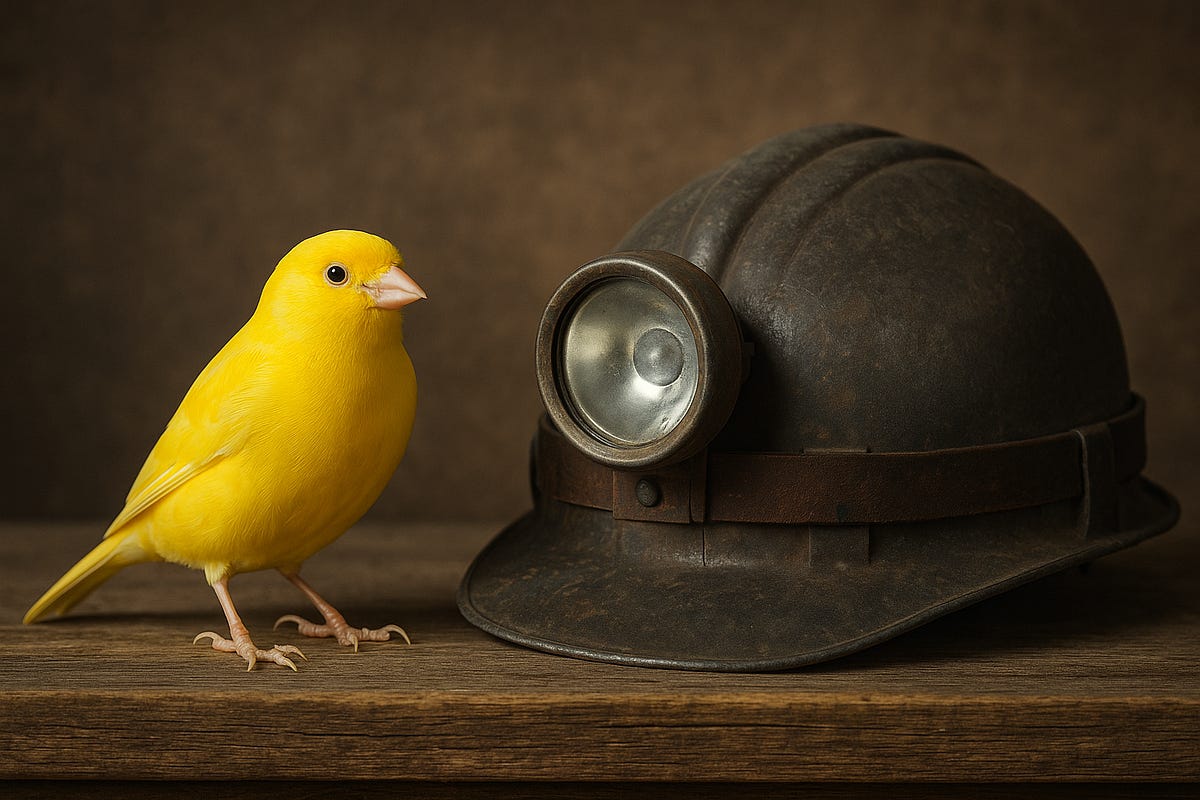
The canary does not fall because it’s weak
There is a thing we do when someone breaks down in a workplace. We look at the person. We examine their resilience, their history, their capacity to handle pressure. We look at the behaviours that have become visible: the difficult boss, the moody colleague, the angry board member, the person who appears unable to cope, or who won’t go along with the way things are done. We are very thorough about this. What is not standard practice is to ask what is in the space in between: the surrounding space that connects everyone inside the system and is an active influence on everything that occurs within it.
A canary in a mineshaft doesn’t fall off its perch because it’s fragile. It falls because it is working exactly as it should, responding honestly to an environment that has become toxic. The canary is the measurement instrument. It is doing its job. Here is the critical thing: what is toxic in the space in between doesn’t go away when the canary falls. It doesn’t go away when the canary is replaced. It stays exactly as it was, waiting for the next one and the one after that, until someone stops looking at the bird and starts looking at the surrounding space in between.
Patterns exist in that space. Patterns can be both generative and destructive; they are how living systems organise and sustain themselves. Generative patterns create connection, coherence and the conditions for things to function and flourish. However, when something fundamental is disturbed and the disturbance goes unaddressed, patterns turn. They become self-perpetuating destructive cycles that embed deeper with every rotation, producing resentment, fragmentation, helplessness and eventually the kind of damage sitting across from me in that conversation.
What turns a pattern destructive? What puts it there and keeps it there, growing it into a cycle that grinds through everything inside it?
Almost always, the same thing: in imbalance of power and control that is never fully accounted for in its impact.
Power, control and what happens when the balance goes
Power, in this context, is the capacity to generate something of value: in an agricultural sector, to produce, to create and to sustain a viable livelihood from what you grow or rear. It is not just the ability to grow, but the conditions that make growing worthwhile. Control is the capacity to have a say over the destiny of what you produce: the ability to negotiate your inputs, the price your produce commands, the conditions of sale and the dignity of the exchange.
When both are in balance, a generative dynamic system exists. People can plan. They can cooperate. They can afford to trust each other and to take responsibility.
When both are imbalanced, incrementally, over years, by forces too large and too diffuse to confront directly, there is a response. That response does not simply disappear. The energy of it does not go away. If it isn’t dealt with, it curdles. It becomes systemic fragmentation marred by collective resentment, helplessness and scepticism. It generates a particular dynamic across the relationships between every entity inside the system: every person, every business, every stakeholder group operating within it.
When that response is not dealt with, this dynamic takes hold. It is typified by three interlocking roles. There is the victim: the one who feels powerless, helpless, at the mercy of forces beyond their control. There is the persecutor: the one on the other end of the power and control imbalance, the one that has more. And there is the rescuer: the one who tries to help, whose help never quite works or is never fully accepted and who over time is repositioned as the next persecutor when the rescue fails.
These roles are not fixed. Any person, any farm business, any stakeholder group can rotate through all three positions. Whoever the imbalance currently favours shapes who plays which role and who gets moved around, disrupting the whole system. A farm owner is victim to the supermarket, persecutor to the neighbouring farm and sceptic of the rescuer arriving with a new programme. A board member arrives as a victim through the farm gate and becomes a persecutor in the boardroom. A CEO enters as a rescuer and exits as the identified cause of everything that went wrong.
The participants rotate. The roles and the interplay do not. The dynamic keeps turning at every level: within the industry, between businesses, inside governance, inside the industry body until it leads to inevitable disintegration. That disintegration shows up as noteworthy events, gossip-worthy incidents, crises that appear unrelated to one another but are not. They are the same pattern, expressing at different levels, at different times. It is worth noting that while this case is heavily victim-centred, the same dynamic can organise around any of the three roles: sometimes it is persecutor-led, sometimes rescuer-led. The roles shift. The interplay does not.
What keeps it from being seen, let alone fully addressed, is another key component of the pattern itself: a layer of avoidance that sits over the whole thing. Because to see it clearly would require acknowledging the full impact of what has happened and in many farming communities, the inherited story of how it used to be is still vivid enough that facing the present reality fully is almost unbearable. The grandfather who made a solid living from a modest piece of land. The father who had standing in the community and something to pass on. Holding onto that story is a safe haven, far more bearable than reckoning with what the industry has become. So the lid stays on and the pattern keeps running.
The biggest space: the industry and its stakeholders
Not long ago, a farm owner in this sector of the WA agricultural industry with a modest piece of land could sell produce at auction, set a minimum price and walk away if the market didn’t meet it. There was a floor. There was dignity. Farm owners could coordinate a collective position and hold their ground. Farms varied in size, some were always larger than others and the playing field was never perfectly even. Yet some level of balance had to exist because without it the industry would never have taken shape in the first place or sustained the communities and livelihoods it did. Power and control, both, more or less, held.
But that structure is gone now.
Today, some farm owners drop their produce at the central markets, an agent sells it on their behalf with little to no say over the price or capacity to say no. Others deal directly with supermarkets. Coles and Woolworths now control roughly 67% of Australian supermarket grocery sales. The national competition regulator, the ACCC, completed a formal inquiry in early 2025 and found unambiguously that Australia’s major supermarkets are among the most profitable in the world, their margins increasing over five consecutive financial years, with a significant bargaining power imbalance operating against fresh produce suppliers specifically. The regulator documented that suppliers fear commercial retribution if they raise concerns. That is not an allegation. That is what Australia’s own competition regulator found after reviewing billions of data points and hearing from more than 20,000 people. So where is the respectful, dignified balance of power and control here?
A national industry body made the numbers starker still in a Senate submission: of every dollar a consumer spends on fresh produce at the supermarket, the farm owner receives less than four cents. Less than four cents in every dollar of the retail price of their own produce, for all the risk, labour and investment they carry.
If a farm owner becomes inconvenient: if they organise, push back, or complain too loudly, the retailer can simply switch to cheaper imported produce. Nobody needs to say this explicitly. It is now woven into the space in between every interaction, every negotiation, every decision about whether to speak up. When you are isolated, when the entity holding your livelihood can simply move on without you, when you are fully invested financially, physically, emotionally, generationally, what do you do? You absorb the imbalance. You endure. And this is happening to an entire industry. That has consequence.
There is another dimension to this that rarely gets named. For years and years, supermarkets shaped their customers’ behaviour, training them to expect year-round availability, convenience, packaged and prepared produce. When consumer sentiment shifted toward sustainability, the supermarkets didn’t absorb that shift. They passed it directly back to the farm owners: you now need biodegradable packaging, reusable containers and certified sustainable supply chains. The consumer habits the supermarkets created became yet another compliance burden placed at the farm gate. The farm owner didn’t create that demand. But they carry it.
Add the growing compliance burden more broadly, the spike in input costs since the Ukraine invasion and now the Middle East, the information asymmetry that technology has created - supermarkets computing market conditions and negotiating positions with a precision that a family operation cannot match. None of it arrived all at once. Bit by bit. Each pressure landed, the industry absorbed it and responded. Then another landed. Then another. Each response is embedded, and what begins as a reasonable adaptation to a real threat becomes maladaptive when it is never addressed at its source. The impact was never fully named, never understood as a whole. No countermeasures were put in place. So the pattern deepened. And over time, once you have absorbed the imbalance and yielded to it enough times, something else happens, you begin to give your power away. Not because it is taken, but because the pattern of yielding has become the pattern. Take more, absorb more, endure more, yield more.
The victim-persecutor-rescuer dynamic expresses itself plainly at this level. Farm owners are victims, not unreasonably, because in important respects they are. The supermarkets, the market agents, the import merchants, the banks: these are the persecutors. The industry organisations, the R&D programmes, the consultants and government bodies arriving with genuine solutions: these are the rescuers. It is important to be clear: the solutions they bring have real merit. Many are well-designed, well-intentioned and valuable. The problem is not the quality of what is on offer. The problem is that when the dynamic has cast someone in the victim role, the rescuer’s offer, however good, is filtered through that lens. It becomes difficult to receive, difficult to engage with fully, difficult to see the value of. The rescue never significantly works; not because the rescuers are wrong, but because nobody has yet gone into the core of what is actually driving the dynamic. And until someone does, the frustration of failing to help curdles into resentment, which makes it easy for the victim to recast even the most genuine rescuer as just another persecutor. Another body that promised and didn’t deliver. Another programme that asked for participation and produced nothing. Another entity to be sceptical of.
The dynamic turns. The pattern embeds. And nothing changes at the level where change is actually needed.
One level down: farm business on farm business
The same dynamic continues between the farm businesses operating within the industry.
Farm owners who once had a basis for trust now operate in an environment where they have been pitted against one another, divided, effectively conquered, until the neighbouring farm is less a community member and more a rival. There are recognised stories of farm owners deliberately giving bad advice to competitors: false information about sprays or treatments, shared in a bar, designed to damage another’s crop. These are not the actions of bad people. They are not doing this out of malice. Most of them, as individuals, are decent. But there is an unconscious drive toward some form of equilibrium in all of this, a seeking of balance through whatever means is available, that moves people from an unconscious place toward actions that in any other context they would not recognise as their own.
This is the engine of much of the damage that follows. When power and control are lost at the containing level above and the loss goes unaddressed, people inside the system will find ways to recover some sense of agency, not through the mechanisms that would actually address the imbalance, but through control exerted over those nearby. Over competitors. Over employees, particularly temporary and seasonal workers who have the least standing to push back. Over the industry body supposed to serve them. The victim at one level can become the persecutor at the next. The imbalance reproduces itself, destructively, at every level below.
Here is how the dynamic plays out between businesses. One natural response to being stripped of power at the industry level is to get bigger: to consolidate, to vertically integrate, to secure your own distribution and buy inputs in bulk. For some farm owners, that strategy worked. It readdressed the imbalance, at least for them individually. But in doing so, it reproduced the same dynamic one level down form the whole industry. The operations that consolidated and grew are now cast as persecutors by the smaller operations who cannot compete with them, the same power asymmetry, the same resentment, just wearing different faces. The smaller operations are the victims. The industry body arrives as the rescuer with programmes, benchmarking and workshops that is met with the scepticism of people who have already learned that rescuers don’t fix the thing that actually needs fixing. When biosecurity outbreaks occurred, some farm owners concealed them rather than report them, not all, but enough. The government body tasked with managing the outbreak became a potential persecutor: one that might shut the farm down, remove what little control remained. Every farm owner for themselves was not selfishness. It was the logic of a system that had lost its collective ground entirely.
When I was working in this sector, I established a financial and production benchmarking scheme, one of the most basic instruments of any functioning industry. It should have been straightforward. It was not. Creating the trusted relationships needed to get it off the ground took significantly longer than anticipated, something not fully understood by the funders, who saw project timelines rather than the depth of relational damage the scheme was having to work through. One farm owner told me directly that if I shared his data with anyone else, he would find me and cause me physical harm. The fear wasn’t just of competitors. It was of market agents, supermarkets, processing and storage facilities: anyone who might use the information to squeeze what was already at the bone.
The resistance also came from another direction entirely. Larger farm owners, in many cases, had no interest in anything that might level the playing field. Their position depended on the gap remaining. Participation would have served the industry. It would not necessarily have served them.
From the benchmarking analysis, most people expected the differentiating factor between successful and struggling farm businesses to be around produce type, region, or scale. It was none of those things. The farm owners who consistently succeeded were the ones who had found a way to move past the victim position, who took responsibility for their operation regardless of what the market was doing around them. Those who managed it could succeed.
The benchmarking work also surfaced something telling: a reticence among many farm business owners to look honestly at their full financial picture, not just the immediate profit and loss, but the balance sheet, the liability position, the structural integrity of the whole operation. It wasn’t that they lacked the intelligence for it. It was avoidance, the same avoidance operating at every other level of this system. Short time horizons, the inability to plan beyond the next crop rotation, the absence of anything resembling strategy; these had embedded so thoroughly that facing the full picture felt genuinely threatening. Survival mode had stopped being a response to crisis and become the standard operating mode. The lens through which everything was seen.
When that is what a farm owner carries into the governance of the industry body, what they bring is not strategy. It is everything the previous levels have put into them.
Into the boardroom
Bring together the short time horizons, the survival mode thinking, the victim positioning, the unconscious drive to readdress the imbalance, the refusal to look hard at reality and the inability to cooperate, and then bring it all into the governance of an industry body set up by farm owners, funded through their contributions and supposed to be there to support them.
Farm owners arrived on the board through three main routes. Some came through the victim lens, dragged reluctantly into service, already carrying more than they could manage, with no real sense of what governing an industry body required. Others arrived with agendas. Some from an unconscious drive to readdress the imbalance they felt everywhere else: to have some say, some control, some power in a world that had been steadily stripping it away. Others from a different position entirely: larger and more dominant farm owners for whom the industry body was an instrument to maintain the status quo and keep a watchful eye on anything that might unsettle their position. These groups tended to stay, sometimes term after term, long past the point of usefulness. The third route was different: the occasional farm owner who arrived with genuine intent, a real desire to contribute to something larger than their own operation. These ones tended to encounter the reality of the boardroom, become quickly frustrated by what they found and leave. Sometimes within a single term.
Unaware, those who remained were governing through the lens of everything the previous levels had put into them. They were supposed to bring intelligence about what was happening among farm owners in their regions: the real conditions on the ground, the actual state of the industry they were constituted to represent. But because they were as separated from their peers as everyone else in the industry, what they brought was the view from their own gate. The board as a collective rarely received a clear steer from the industry it was meant to represent. As a result it never provided a clear steer down to the industry body it was meant to govern.
Board meetings degraded, consistently, not occasionally. Members actively undermined each other and at times the structure of the board itself, making meetings that, from the outside looking in, sometimes appeared entirely futile. The pattern reproduced itself in the room: reactive, incapable of holding a long view, organising around immediate grievance, finding persecutors and victims in every agenda item. People in formal governance positions behaving as people behave when they have been pushed to their limits and have never been given language for what they are carrying.
Without strategic horizon, they compensated by exceeding their remit and reaching into the operational. They micromanaged processes they didn’t understand and were continually surprised by events that emerged from outside their time horizons. They wanted access to the financial records, the detail of every project, the day-to-day decisions that are properly the domain of the people employed to make them. This was not malice. It was the same drive that produced the bad advice in the bar and the physical threat over benchmarking data, the drive to readdress, through whatever lever was available, the imbalance that could not be addressed where it actually lived.
The dynamic completed itself in the boardroom. Farm owners who were victims in the market became persecutors inside the industry body. The industry body, the rescuer, became their next target. And the people employed to serve the industry were caught in the middle.
Which made that industry body a precise instrument; a weather vane. What was happening inside it at any given time was a faithful reproduction of what was happening in the industry it served. No coincidence. Pattern replicated. The same resentment, the same fragmentation, the same refusal to hold a long view, the same oscillation between helplessness and overreach. Read the industry body and you were reading the industry. The disintegration inside the boardroom was the disintegration of the industry, expressed one level down.
Worth noting too: I observed something similar playing out in the research and investment funding bodies operating within this sector, not from the inside, but from who I could see putting themselves forward for them. The same routes. The same motivations. What people carry into one room, they carry into the next.
Inside the industry body: the board and the CEO
With no clear mandate, no strategy, no coherent governance or accountability structure, the role of CEO became structurally impossible to do well. What the pattern demanded was a rescuer: someone to absorb the chaos, make everyone feel that progress was happening, provide the appearance of forward movement without lifting the lid on what actually needed to change. And so, one after another, that is what the CEOs became: shrinking, people-pleasing, endlessly reactive, trying to be useful to whoever was most loudly demanding something. Not because they weren’t capable individuals - far from - but because the pattern placed them as such.
The rescuer’s fate on this dynamic is specific. It cannot succeed. The system does not want the underlying problem solved, because solving it would mean leaving the victim position and the victim position is the one fixed point around which everything else organises. So the rescue fails. And when the rescue fails, the rescuer is repositioned as the next persecutor. Another CEO who let the industry down. Another leader who didn’t deliver. Another person who turned out to be the problem.
The avoidance that had characterised the industry’s response to its structural crisis, the same lid-keeping, the same refusal to look directly at hard reality, now expressed itself inside the industry body with equal force. One CEO developed an alcohol problem. The handling of it became a case study in the avoidance aspect of the pattern. Everyone in the industry body knew. It was formally escalated. The board knew. They buried their heads.
The response was the same one the industry had been making for years: sweep it under the carpet, look away, keep moving. In doing so, they failed the CEO. Left unaddressed and unsupported, what had started as a serious situation was allowed to escalate and embed deeper and the longer it went on, the greater the cost personally. The individual needed the board to act. They didn’t.
That period of inaction also tore through the culture of the industry body because what it communicated, categorically, to every person inside it was this: nothing you raise of substance will be acted upon here. If the board will not address something this serious and this visible, then any concern, any grievance, any valuable idea you have will go unheard. You are on your own.
The CEO was eventually removed but only after the hand was finally forced when an incident threatened to become a legal problem. Only then did the board appear to act.
There was a period of apparent but performative renewal. Promises of change. A full review. People thought they could breathe. But nothing of substance happened. And then the board, without coherent process, with nobody truly taking responsibility and with the same patterns embedded in the selection process itself, chose the next CEO. Before long there were serious issues and he too finished under a cloud. What appeared to be a completely new set of problems was the same pattern, wearing different clothes. The script was identical.
Inside the industry body: what it was like to work there
The learned helplessness that had operated in the industry, in the farm businesses, in the boardroom, now lived inside the walls of the industry body itself.
Without consistent vision from any of the CEOs, without any strategy to work toward, the people inside became isolated from one another in a way that mirrored the isolation of the industry itself. There were a number of us delivering extension projects, genuinely valuable work, well-funded, carefully designed. But there was no overarching narrative to hold it all together. No way to show how individual pieces contributed to a greater whole. No capacity to harvest the collective intelligence being generated into something the industry body could build on and own. The sum was less than its parts. And without a coherent story of what the industry body was building, it struggled to demonstrate its own value clearly to funders, to farm owners, to anyone.
And so, in the end, we became isolated too. Not just from one another inside the industry body, but from the very industry we had come to serve. Farm owners wouldn’t return calls. Workshops and presentations were poorly attended. The distrust that had built up over years in the industry’s space in between had made the industry body itself another entity to be wary of.
Because the true state of those relationships, the scepticism, the non-engagement, the fragmentation was genuinely difficult to explain to funders looking for clean metrics, there was pressure to present a rosier picture of connection than the relational reality allowed us to fully demonstrate. This was particularly acute when tendering for new work. Our jobs and livelihoods, which rested on project performance, depended on demonstrating engagement that the preceding account explains exactly why we struggled to deliver. We carried the weight of that gap. And yet some progress did happen. Some of us, through sustained relationship-building, through persistence that bordered on stubbornness, through working in spite of the system rather than with it, did get things across the line. However, any real progress came at the expense of enormous effort. It required building trust from scratch, relationship by relationship, in an industry whose space in between had been saturated with reasons not to trust. And those relationships, built individually, rarely transferred. A connection I had built with a farm owner didn’t carry across to a colleague and their project. The isolation wasn’t just between individuals; it was between projects, between everything we were trying to do. The sum remained less than its parts.
We sat inside an industry body trying to help an industry that had learned not to trust help, funded to do work the industry struggled to take up, reporting on relationships we genuinely tried to build but found it hard to fully account for.
Staff came in good faith. They created things of genuine value. They were told, by the board, by the industry and sometimes by project funders, that they were the problem, because the pattern needed a persecutor, someone to blame, and they were the ones who were visible.
So they sat inside it and began to wonder if it was them. Because when everyone around you is pointing at you and you cannot see the pattern in the space in between, particularly when no one around you is recognising it or acknowledging it, that is the conclusion that makes sense. The struggling project manager with little to show for their efforts, the staff member who couldn’t explain why engagement was so difficult: these are what everyone looked at. The pattern generating all of it stayed exactly where it was.
All of these levels interlock. They feed each other, perpetuate each other, round and round. The industry into the businesses, the businesses into the boardroom, the boardroom into the industry body, the industry body back out into the people who came to serve it and then back out into the industry itself again through efforts.
The disintegration this produces gets read as a series of unrelated events: weakness, poor business acumen, anomalies, bad luck, the wrong people in the wrong roles, a farm that couldn’t make it work, a staff member who couldn’t handle the pressure, an industry body that never quite found its feet. Not connected. Not the same thing. Just a run of unfortunate circumstances.
And so it continues. The pattern in the space in between stays exactly as it is. Waiting for the next person who comes in good faith to help.
What this actually costs
She is not an abstraction. She is a person who came to this work with genuine capability and genuine care, and left years later unable to trust her own perceptions. It did not happen in a single event. It happened the way erosion happens, bit by bit, imperceptibly, the consequences and impacts accumulating and building until they passed the threshold of too much and one day you discover how much has gone.
She is the latest in a sequence I have watched personally. I have seen the same dynamic replicate in other sectors, other industries, other organisations. Wherever power and control are imbalanced in a living system and the loss goes unacknowledged together with the fullness of the impact, the same pattern follows. The names change. The industry changes. The nature of it shifts, sometimes more persecutor-led, sometimes more rescuer-led. But the roles and the interplay remain.
In farming specifically, the cost extends far beyond the individuals who work in industry bodies. It lives in the farm families themselves. In the stoicism that runs through farming culture, the pride in endurance, the refusal to name what is being carried, which means that what the farm owner absorbs from the market and the industry never gets spoken, only transmitted. It lives in the wives and partners who receive the overflow at the end of the day, who carry the ambient anxiety of the farm as their own. In the children who grow up inside it, inheriting the pattern before they can name it.
The 2023 National Farmer Wellbeing Report, commissioned by Norco in partnership with the National Farmers’ Federation, found that close to half of Australian farmers — 45% — have had thoughts of self-harm or suicide. Nearly a third — 30% — have attempted it. One Australian farmer dies by suicide every ten days. Farmers are twice as likely to die by suicide compared to the general population. Financial stress and cost pressures, the direct expression of the power and control imbalance described throughout this article, were among the top three triggers named.
These numbers do not live in reports. They live in families. In the person sitting across from me, who finally cried with relief because she had come to realise, for herself, that she wasn’t mad. In the farm owner who confided quietly, years ago, that he hadn’t taken a day off in three years and didn’t know who he was anymore without the work. In the partners of people who worked in that industry body, who had equally difficult years of their own, absorbing what came home every evening.
The sector is also contracting. 34% of farm owners considering leaving. An 8% decline in produce businesses in just four years. No young people entering. The pattern that was supposed to be a survival response has become the mechanism of the industry’s own dissolution.
And the funding bodies keep commissioning projects on production efficiency.
The space in between is real. The pattern can be named.
I am not writing this to perform outrage. I’m writing it because I sat with her and watched the relief move through her when she finally understood she hadn’t failed. And because what is happening here is not isolated; it is systemic, it is replicating and it has gone on long enough.
The space in between is real. The patterns that live in it are real. This needs saying plainly, because the default response to everything described here is to look at the individual incidents: the difficult CEO, the dysfunctional board, the struggling farm business owner, the burnt-out staff member, and miss what is actually operating. Patterns are not metaphors. They are living dynamics lodged in the space in between people and systems, structuring behaviour, determining outcomes, rotating everyone through roles they didn’t choose and don’t understand they’re playing.
Funding bodies will keep commissioning projects tied to production efficiency. Ministers and government departments will keep wanting announceable wins: clean, tidy projects with visible outcomes and tight metrics. Industry bodies will keep hiring new CEOs and hoping this time is different. None of it touches the pattern. None of it addresses what is in the space in between. The dynamic will keep finding new actors, new incidents, new apparent causes and the same thing will keep playing out, into the next person who came to help.
And here is the thing that makes this urgent rather than merely sad: any solution that arrives before the pattern is cleared will simply replicate it. A new CEO steps into the same dynamic. A new programme lands in the same scepticism. A new strategy collapses on the same avoidance. The space in between shapes everything that moves in it. Until it is worked on directly, every intervention, however well-designed, however well-intentioned, becomes another actor in the same play. The real solutions for this industry and its people, solutions that nobody can even see yet because the space in between is so cluttered with destructive patterns, cannot surface until the space is cleared. That is not a counsel of despair. It is the most practical and urgent thing in this entire article.
I should be honest about something. When I was working in this sector, I could see much of what I’ve described here. I didn’t yet have the full knowledge of what to do about it. I do now.
It begins with the one thing the pattern is specifically designed to prevent: naming what is actually happening. Not the incident. Not the person. The power and control imbalance at the root of it, the pattern it has generated, the roles, the interplay, the dynamic turning at every level.
It requires open and robust minds.
Open and robust minds to sit with the true weight of the impact, which is existentially confronting because understanding it fully means acknowledging how pervasive this has become. Much of it persisted because, for a long time, nobody had the framework of understanding to see it clearly, let alone the tools to address it. Not just in this sector but across other industries, organisations and communities where power and control have also been imbalanced and the loss has never been named. This hasn’t been normalised. It hasn’t been named at this level before. That is not a condemnation. It is a starting point.
Robust enough, too, to go through a structured process of dismantling it. Not a single workshop. Not a new appointment. Sustained, committed work at the level where the pattern actually lives; and the commitment to guardianship to ensure that what is cleared stays cleared and doesn’t find its way back in through a different door.
The farm owners, the farm families, the industry body staff and everyone downstream of it all are worth more than a system that keeps grinding the same pattern through the same people and wondering why nothing changes.
The canaries keep falling. The mine stays open.
Someone needs to check the space in between.
Very nicely written Bryn, what often felt, unseen and unsaid. This may be a good share with Gabrielle Chan of The Guardian Author of “Rusted Off” and “Why you Should Give a F About Farming”.